Déjà-vuism Art
(Manuscript No. 7)
Like my fellow artist Mondrian, like myself, I wish to express a universal harmony. When Purity travels through Time, it leaves a little sparkle upon different artists who share a dream. An idea.
Inès.
_________________________________
Contemporary Art · Conceptual Art · Expressive Abstraction · Textual & Symbolic Art
Déjà-vuism® Art lies at the intersection of concept, abstraction, gesture, word, and symbol. Some works may evoke Expressionism, Fauvism, primitivism, or gestural painting, without entirely belonging to any of these schools.
Another +, a subtle difference.
_________________________________
“Text-based art. You create the artwork in your mind as you read my words. While reading, and then at the end, you take flight. You sense. You feel, _”
_
Déjà-vuism® Art is an artistic movement created and named by Inès Arab, founder of TheBroithers’s®. It combines painting, handwritten words, symbols, texture and visual poetry to create works of art that are meant to be looked at as much as they are meant to be read. Pleasant thoughts.
Its principle is to begin with signs, emotions or images that may feel familiar, like an original image, a déjà-vu, and open them up to new interpretations of universal themes: childhood, identity, difference, memory, the living world, love… towards Peace.
Each work functions like a door. You can enter through a colour, a word, a texture, a memory, a symbol or an emotion. There is no single right interpretation: the viewer completes the work with their own story.
This artistic movement, which she chose to name herself, an invented and protected term, created to be shared... was born from a strong sense of self-irony, a playful nod to the expression “déjà-vu”, and a gentle teasing of herself and others. Because sometimes, we spend our lives passing by essential things without ever truly seeing them.
Déjà-vuism® Art seeks to make a part of the invisible visible: our cracks, our strengths, our questions, and sometimes a few answers. It also seeks to bring comfort, to dare to embrace innocence, to put words to what is difficult to touch, and to make Art feel less intimidating.
This artistic language does not seek to fit perfectly into any existing school or movement. It was born from years of writing, observing the world, and a desire for Beauty. Nor does it seek to impose an answer, but rather to open paths of interpretation and leave everyone free to follow their own.
Toward… Peace.
Inès Arab (aka TheBroithers’s) seeks to send echoes and light towards other homes, towards the other beacons that we are. To build strong bridges between worlds. To all the artists who, yesterday and today, stand for peace… thank you.
[Read his book. And maybe you'll understand.]
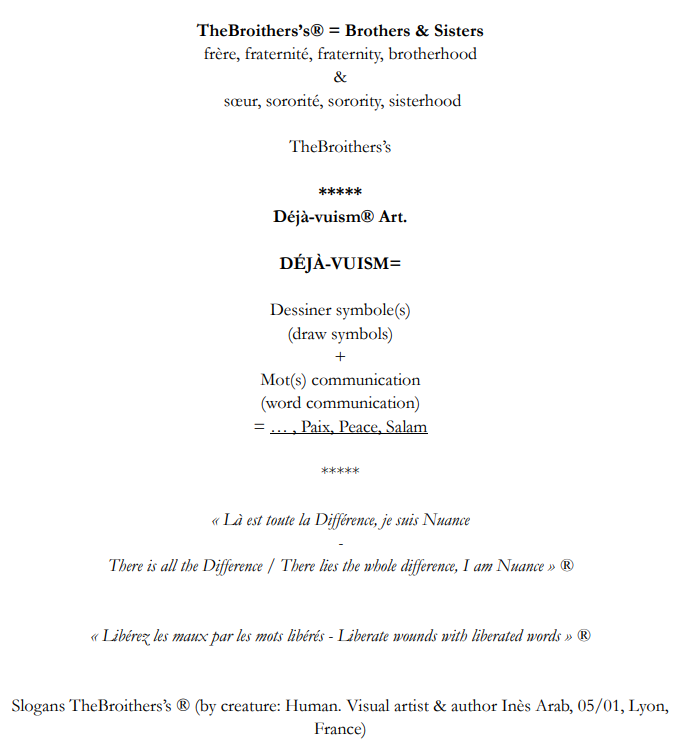
Artistic movement
Who is TheBroithers's?
Aura, song, painting, language, poetry, and symbols.
One day, his niece Tanya, when she was nine years old, said to him as she pointed to one of his paintings:
“Auntie (Tata), it’s street art, chic and elegant all at once.”
Thank you.
Part of a message.
_
Resonances
Over time, visitors, collectors, and art lovers have drawn various parallels with certain artists such as Jean-Michel Basquiat (for his signs and symbols), Cy Twombly (writing that ceases to be merely text and becomes pictorial material), Zao Wou-Ki, Pierre Soulages, Mark Rothko, Nicolas de Staël, José Parlá, Ben Vautier, Banksy (humanistic dimension, social commitment, peace, and brotherhood), Gaston Chaissac...(with his innocence, characters, spontaneity, and the convergence of writing, drawing, and painting). Many children and adults spontaneously express an affinity for the small characters found in Inès Arab’s works. Both a writer and a painter, Chaissac also embodies this convergence of words and images that runs through Déjà-vuism® Art. These parallels do not constitute a lineage, a claimed influence, or a hierarchical comparison. They simply reflect the echoes that certain people have perceived when viewing TheBroithers’s works. Every artist contributes their own unique element to the history of art. TheBroithers’s mission is to contribute theirs.
Not to mention… my dear colleague… Wassily Kandinsky: colors, forms, musicality, spirituality, and synesthesia. Like Kandinsky, Inès Arab is a synesthete. This sensory experience naturally fuels the connections between words, colors, sounds, shapes, and emotions that make up her artistic language, though it does not, on its own, define her approach. I’m thinking of this painting, “Musiqa” by TheBroithers’s… what a brilliant idea…
Speaking another language.
These are resonances. Not an identity.
_ DifferenceNuance
"It's different from what we see"
(Verbal comments from visitors who discovered his art at an art fair.) That was the message that came up time and time again. Instinctive.
Even though the visitors didn’t know each other.
_
I am Nuance
From the earliest traces of human activity to contemporary visual languages, human beings draw, write, leave marks, and invent signs and symbols to express what they feel, what they hope for, what they fear, and what they love. We still seek to make visible what is not. Some works are raw and essential; others are more elegant, contemplative, sharp, or full of energy. Innocence can meet sophistication. Instinct can meet construction. Silence can meet language. Simple signs can carry immense questions. Who are we? What connects us? What remains when we strip away appearances? ... How can we live in the world with greater peace? Déjà-vuism® Art belongs to the present, yet keeps its eyes open to what came before. It can resonate with abstraction, expressionism, surrealism, conceptual art, certain primal forms, gestural expression, and contemplation without seeking to replicate or belong entirely to any of these schools. This is precisely where its Nuance lies.
While various artistic traditions have explored painting, words, symbols, gestures, or concepts, Inès prefers to let them come together freely. Her synesthesia naturally fosters these connections between colors, shapes, sounds, words, and emotions.
_
The symbol
The symbol holds an essential place in Déjà-vuism® Art. Since the earliest civilisations, human beings have entrusted symbols with their fears, beliefs, and desires for protection, happiness, love or peace. In TheBroithers’s, the symbol becomes a language capable of transcending words and, sometimes, even borders.
An extremely simple sign can carry an immense idea. A form can awaken a sensation without us immediately knowing why. Something feels familiar. A memory? An emotion? An ancient image? Déjà vu.
The symbol then becomes a bridge between the intimate and the universal, the ancient and the contemporary, the child and the adult, the self and the other. It does not necessarily dictate what should be understood. It opens.
And the viewer continues.
_
A few pieces of the mosaic
A few pieces of the mosaic. The rest is within you.
To create images that invite us to pause. To feel. To smile, sometimes. To reflect. And perhaps to walk away with something we did not have when we arrived.
An image. A word. An emotion. A little light.
_
A sweet treat with a cause
Déjà-vuism® Art is also about life itself. About the possibility of creating without denying our wounds, but without giving them all the space. About preserving something: a seed of innocence in the heart, I hope… preserved. There is so little of it left in this world and, yet, it is so deeply sought after.
This gentleness does not mean a lack of strength. It is a choice. To build resilient and solid bridges between worlds. To foster dialogue among different sensibilities, histories, and cultures without seeking to make them identical. Difference. Nuance. To each their own interpretation. To each their own journey.
And behind the forms, the colours, the words, the symbols and all their Nuances, one essential direction remains:
Peace.
_
To all the artists who, yesterday and today, stand for peace… thank you.
Déjà-vuism® Art is also your space.
Inès Arab - TheBroithers’s® , Visual Artist · Artist-Author
Founder of Déjà-vuism® Art
secret
